
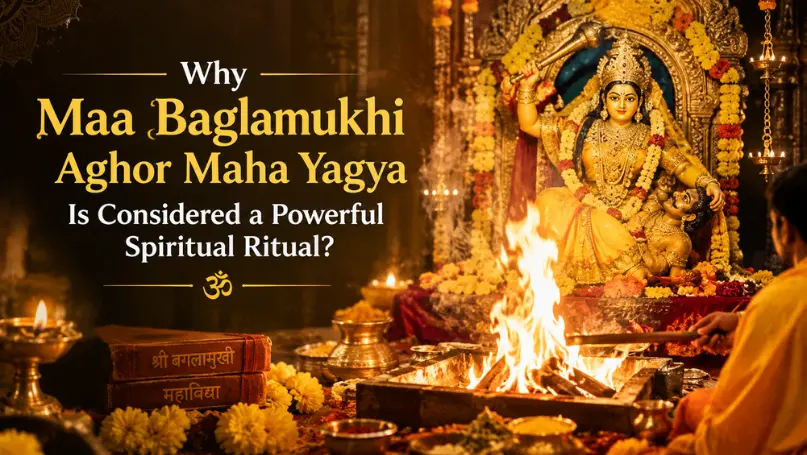
There is a reason certain spiritual rituals have held a distinct place in Hindu traditions for generations. Their significance is not simply about performing a ceremony or making offerings. It comes from the intention, discipline, symbolism and spiritual principles that come together during the practice. Maa Baglamukhi Aghor Maha Yagya is one such ritual that is traditionally regarded as especially powerful.
But what actually makes it powerful?
It is not just the scale of the Yagya, the number of offerings, or the chanting of a powerful mantra. Its deeper significance comes from several factors working together. Maa Baglamukhi’s association with Stambhana Shakti, the role of Agni, focused mantra practice, Sankalp, collective participation and the Aghor perspective all contribute to the intensity associated with this spiritual ritual.
What Makes Maa Baglamukhi Aghor Maha Yagya Powerful?
Below, we explore the key factors that traditionally contribute to the spiritual power and intensity of this Maha Yagya:
1. The Unique Energy Associated With Maa Baglamukhi
Máa Baglamukhi, one of the Ten Mahavidyas, is at the core of the ritual and is traditionally linked to Stambhana Shakti.
The word Stambhana means the ability to stop, to control, to subdue or to restrain opposing forces. That’s why Baglamukhi worship is generally associated with opposition, conflict, and disturbing influences.
However, this idea goes deeper than simply stopping an external enemy.
Stambhana may also have an inner meaning: The power to direct the fear away before it becomes overwhelming; the power to control the tongue when it goes out of control; and the power to not lose the battle when it gets tough.
The symbolism of Maa Baglamukhi is very powerful: not necessarily stronger to do more, but when and how to be still.
2. The Combination of Mantra and Agni
Yagya consists of the merging of mantra, Agni, and Aahuti; one of its most distinguishing characteristics.
Mantra provides the practice with a clear sound and rhythm. Agni is the sacred medium of the offering, and Aahuti is the offering of something with intention.
The power of this combination lies in its concentration. Routine does not mark prayer as something done on an ad hoc basis, but rather establishes a ritual framework that brings attention to a particular spiritual goal over and over again.
Hence, a Baglamukhi Yagya is not just about lighting a sacred fire. The fire, mantra, offering, and intention combine to make this ritual’s spiritual power.
3. Focused Mantra Sadhana
Mantra becomes meaningful through disciplined practice.
During an elaborate spiritual observance, repetition is accompanied by concentration, consistency and a conscious intention. The mind is required to remain connected with the practice instead of constantly moving toward everyday distractions.
In this sense, the significance of mantra Sadhana lies in more than the words being spoken.
It involves:
- regularity
- focused attention
- discipline
- correct intention
- sustained spiritual engagement
This focused approach is an important reason mantra-based rituals are traditionally considered more intensive than ordinary devotional prayer.
4. The Aghor Perspective of Fearlessness
The term “Aghor” can be misinterpreted. It is occasionally described mysteriously or in a fearsome way but this is not sufficient to capture its more profound spiritual dimension.
Aghor is generally linked with transcending fear, aversion and rigid reactions. It helps the individual to stand firm against hardships instead of fearing them and responding to each one of them.
This is in keeping with the concept of Maa Baglamukhi.
In Baglamukhi, the principle is to calm the chaotic forces, but the Aghor is in the process of cultivating the inner strength to stand firm amidst the chaotic forces.
That makes the practice less about fear and more about developing inner stability.
5. The Collective Strength of a Maha Yagya
In some respects the whole ceremony of a Maha Yagya is a more involved spiritual activity than the worship of an individual each day.
It may contain:
- More than one practitioner or participant.Several practitioners/participants.
- extended mantra recitation
- coordinated offerings
- a shared Sankalp
- sustained ritual discipline
However, it would be untrue to claim that the more people get involved in the ritual, the more powerful it is.
Collective focus is deeper.
If there are a lot of people involved with the same intent and in the same ritual discipline, the experience is collective. The size of the event does not diminish the intensity, but there is significance in the quality of the participation.
6. Sankalp Gives the Ritual Purpose
It can be a very detailed arrangement, but with no intent, it turns into a ritual.
This is why Sankalp is a part and parcel of the understanding of the spiritual duty of a Yagya. It provides guidance for how it is to be observed, and connects the outward ceremony with its purpose.
What Sankalp is, is to be deliberate about the intent behind the spiritual practice and not just assuming that it is a hurried solution to a problem.
This is one of the subtle aspects that makes the practice of the spiritual discipline rich: between intention and action.
Why the Power of Baglamukhi Worship Is Not Limited to Enemies
Much of the popular discussion around Maa Baglamukhi focuses on enemies, opposition and external obstacles. These associations have a place in the traditional understanding of the deity, but they do not have to be the entire story.
Consider the problems that can exist within a person:
- reacting in anger before thinking
- speaking when silence would be wiser
- allowing fear to influence important decisions
- becoming mentally disturbed by constant conflict
- losing clarity under pressure
These are also forces that can disturb a person’s stability.
From this perspective the symbolism of Stambhana Shakti becomes more approachable. It can be the wisdom of knowing what to restrain before it causes greater damage.
This inward dimension is especially useful as it takes the discussion out of the realm of fear-based concepts and into self-control, clarity and inner strength.
What Makes an Aghor Maha Yagya Different From an Ordinary Puja?
The difference is not simply that one is “more powerful” than the other.
A Puja may primarily provide a devotional setting for worship and prayer. A more elaborate Yagya can involve a greater degree of ritual coordination, mantra discipline, offerings and sustained participation.
The distinction can be understood through a few broad factors:
| Ordinary devotional practice | Maha Yagya |
| Often more individual | Can involve collective participation |
| Usually shorter | May be more extensive |
| Primarily devotional | Combines devotion with a structured ritual framework |
| Personal prayer may be central | Sankalp and coordinated ritual activity may play a larger role |
The exact form varies according to tradition, so these should not be treated as rigid rules. What matters is understanding that ritual scale and ritual purpose are not the same thing.
Why Proper Guidance Matters?
It is not enough to follow instructions that can be located in online resources when it comes to Aghor-related practices. It’s also crucial to know the tradition and have the correct discipline.
- Traditional Understanding: An understanding of the intent behind a practice, rather than the procedure.
- Proper guidance of Right Discipline: Mantra, Sankalp and ritual practices.
- Avoiding Misconceptions: Tradition vs. fear-based claims and how to avoid misunderstandings.
- Experienced Guidance: Clearly and respectfully presented by experienced guidance: Acharya Suryansh.
The Real Reason This Ritual Is Considered Powerful
Combined, all these factors provide a clearer understanding of the importance of Maa Baglamukhi Aghor Maha Yagya.
It is associated with its traditional power with a combination of:
- Maa Baglamukhi’s Stambhana Shakti
- Focused mantra Sadhana
- Agni and Aahuti
- Clear Sankalp
- Collective spiritual discipline
- The Aghor stress on being unafraid
- A formal conventional structure
The true depth is found in the ways that these elements complement each other. The mantra is the focus, Sankalp is the direction, Agni is the medium for offering, collective participation is the intensity and the symbolism of Maa Baglamukhi is the character of the practice.
Conclusion
This is a powerful spiritual ritual in many respects not simply due to its complexity, but also to the various aspects of it. The principle of respecting and taking seriously a practice traditionally associated with Stambhana Shakti, disciplined mantra practice, Agni, Sankalp, group focus and the Aghor view.
Most importantly, it shouldn’t be ignored because of its overnight results. If you can be led and understand the meaning of the symbolism, then you have a more fulfilling spiritual experience. Acharya Suryansh can offer a better perspective to those who are interested in traditions which have a sense of clarity and discipline.


